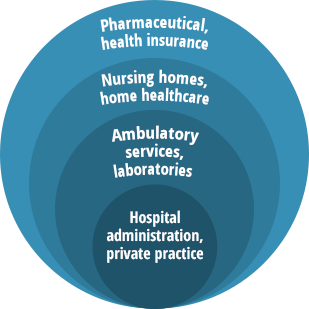
Careers in healthcare administration are in high demand. The Bureau of Labor Statistics projects 23% employment growth for medical and health services managers from 2024 to 2034, nearly six times the national average, with a median annual wage of $117,960. Roles span hospitals, clinics, nursing homes, insurance companies, and government agencies.
The Bureau of Labor Statistics projects roughly 62,100 annual openings for medical and health services managers, including both newly created jobs and replacement openings. That number reflects something bigger than job listings: as hospitals merge, clinics expand, and an aging population drives up demand for care, someone has to keep the systems running. Healthcare administrators are those people. Their work doesn’t touch patients directly, but it shapes the conditions under which care is delivered, financed, and improved.
This guide covers what healthcare administrators actually do, which degrees lead where, how career paths develop over time, and what salaries look like at different levels of experience and seniority.
What Does a Healthcare Administrator Do?
Medical and health services managers (the BLS classification that covers most healthcare administration roles) plan, direct, and coordinate the business side of healthcare delivery. The settings vary widely: hospitals, physician group practices, nursing homes, outpatient clinics, insurance companies, and government health agencies all employ administrators. The job isn’t patient care. It’s making sure the organizations that deliver patient care function well.
Specific responsibilities depend on the size and type of the organization, but most administrators handle some combination of the following:
Planning and coordinating medical and health services across departments or entire facilities
Developing and monitoring budgets, patient fees, and billing systems
Keeping up with healthcare policy, regulations, and compliance requirements
Supervising department heads and assistant administrators
Managing staff scheduling, hiring, and compensation
Working with governing boards on high-level organizational decisions
An administrator might manage a single medical practice, oversee a hospital department, or run a multi-facility health system. Titles vary and may include healthcare executive, hospital administrator, practice manager, or department director, depending on the organization.
The BLS identifies a bachelor’s degree as the typical entry-level requirement for medical and health services manager positions. Many hospital-level and senior leadership roles prefer or require a master’s degree, such as an MHA, MBA, or MPH, though requirements vary by employer and organization size. Some professionals pursue doctoral-level study to move into academic, large-system executive, or health policy roles.
Degrees in this field stack well. Healthcare administration degree programs start at the associate level, but a Bachelor of Healthcare Administration (BHA) is the common entry point for management-track careers. A Master of Healthcare Administration (MHA) builds on that foundation with the depth needed to manage an entire facility or health system. Incremental advancement in the field often mirrors incremental advancement in degree level.
When evaluating programs, accreditation is worth checking. The Commission on Accreditation of Healthcare Management Education (CAHME) accredits graduate-level programs. At the undergraduate level, look for programs certified by the Association of University Programs in Health Administration (AUPHA). Both credentials signal that a program meets recognized quality standards. Employers in this field know the difference.
The phrase “healthcare administrator” covers a wide range of specific roles. Most fall under the BLS category of medical and health services managers, but the titles, settings, and scopes vary considerably. Here are some of the most common career paths.
Hospital Administrator / CEO
Manages all aspects of running a hospital, from financial operations and regulatory compliance to clinical department oversight and long-range planning. Large health systems may have multiple layers of administration beneath the CEO, including COO and departmental director roles.
Projected growth (2024–2034)
23%
BLS median (hospitals)
$145,390
Nursing Home Administrator
Oversees the day-to-day operations of a nursing home or long-term care facility, covering staffing, admissions, facility maintenance, and compliance. All states require nursing home administrators to be licensed, with most requiring a bachelor’s degree and a state-approved training program as minimum qualifications.
Projected growth (2024–2034)
23%
BLS median (nursing care)
$106,520
Practice Manager
Runs the business operations of a physician group practice or specialty clinic, handling scheduling, billing, compliance, HR, and facilities management. As private practices have grown larger and more administratively complex, demand for experienced practice managers has increased alongside the expansion of physician offices.
Projected growth (2024–2034)
23%
BLS median (physician offices)
$134,330
Health Information Manager
Manages patient records, data systems, and health information infrastructure. This role sits at the intersection of healthcare administration and health informatics, and it’s increasingly tied to electronic health record (EHR) implementation, interoperability requirements, and HIPAA data security compliance.
Projected growth (2024–2034)
23%
BLS median (outpatient centers)
$129,500
Healthcare administrators also find work in home health agencies, laboratory services, public health departments, pharmaceutical companies, and health insurance firms. The educational requirements are similar across settings, though some roles require additional state licensure. Nursing home administration is one of the clearest examples: every state requires administrators in that setting to hold a license.
Career Progression in Healthcare Administration
Most healthcare administrators don’t start at the executive level. The typical path begins with a department-level role: managing one unit within a hospital, running a small clinic, or working as an assistant administrator in a larger organization. These early positions build the operational knowledge that senior roles depend on.
From there, advancement usually follows education and experience in parallel. A professional with a BHA and several years of experience might move from department manager to a broader healthcare manager role before advancing to facility administrator. Adding an MHA opens the door to multi-facility leadership and C-suite positions. Some administrators come from clinical backgrounds, such as nurses, lab managers, or therapists who moved into administrative roles. Their firsthand understanding of care delivery can be a significant advantage in hospital and outpatient settings.
What tends to matter most at each stage is documented results: operational improvements, budget performance, and staff retention. Employers promoting from within want evidence that someone can handle a greater scope. Advanced credentials signal readiness. Demonstrated outcomes make the case.
Is Healthcare Administration a Good Career?
The data points to yes. The BLS projects 23% employment growth for medical and health services managers from 2024 to 2034, much faster than the average for all occupations and faster than most other management fields. That growth translates to roughly 62,100 annual openings, including both new positions and replacements. Two durable forces are behind it: an aging population that needs more care, and an increasingly complex regulatory environment that requires more administrative expertise to manage.
23%
Projected employment growth for medical and health services managers from 2024 to 2034, according to the Bureau of Labor Statistics. Much faster than average.
Nursing home and long-term care administration is one area where demand is likely to be especially strong, as baby boomers continue to age into settings requiring residential care. Physician practice management is another growth area, as independent and group practices have grown larger and harder to run without dedicated professional management. Neither trend is going away soon.
Skills Healthcare Administrators Need
Healthcare administration draws on business management skills and healthcare-specific knowledge in roughly equal measure. The roles that pay the most and carry the most responsibility tend to require depth in operations management and financial acumen first, with communication and leadership skills running close behind.
Operations Management
The ability to oversee complex, multi-department organizations, balancing competing priorities, managing workflows, and ensuring daily operations run smoothly across clinical and administrative teams. This is the skill most closely tied to compensation at the senior level.
Financial Management
Healthcare administrators work with significant budgets. Understanding revenue cycles, managing expenses, reading financial statements, and projecting costs are nearly universal in senior job descriptions and among the most valued capabilities a candidate can bring.
Regulatory and Legal Knowledge
HIPAA, Medicare, and Medicaid regulations, Joint Commission standards, and state licensure requirements. Administrators are responsible for keeping their organizations compliant. The regulatory environment changes regularly, and staying current is part of the job.
Communication and Leadership
Healthcare administrators work across professional disciplines: physicians, nurses, insurers, regulators, and governing boards. Clear written and verbal communication, and the ability to lead teams with very different training and priorities, are constant requirements.
Analytical Thinking
From evaluating patient outcome data to making staffing decisions under pressure, strong analytical skills help administrators identify problems quickly, assess their options, and act decisively in high-stakes environments.
Healthcare Administration Salary
Salaries in healthcare administration vary by setting, region, years of experience, and organization size. According to the Bureau of Labor Statistics, the median annual wage for medical and health services managers was $117,960 in May 2024. The top 10% of earners in this occupation reached $216,750 annually, while the bottom 10% earned approximately $67,900.
Industry makes a significant difference. The table below shows average annual salaries by employment setting, based on 2023 BLS occupational employment data.
Industry
Managers Employed
Average Annual Salary
Merchant Wholesalers
2,510
$233,160
Pharmaceutical and Medical Manufacturing
1,390
$231,070
Scientific Research and Development
8,340
$228,170
General Medical and Surgical Hospitals
147,250
$145,390
Physician Offices
68,370
$134,330
Outpatient Care Centers
38,150
$129,500
Home Health Services
25,750
$109,300
Nursing Care Facilities
28,100
$106,520
Interview: Inside a Healthcare Administration Career
Bryan Ayars took an unconventional path to the C-suite, starting as a teenager on a local ambulance before earning degrees in healthcare administration and public health, then working across hospital administration, state government, and consulting before becoming CEO. He has led Community Health Programs, Inc., a federally qualified health center in Berkshire County, Massachusetts, for more than five years.
Interview with a Healthcare Administration Professional
Bryan Ayars
CEO, Community Health Programs, Inc.
How did you wind up as CEO of a network of health centers?
I took a rather indirect path to my current position, starting as a volunteer on a local ambulance when I was a teenager and becoming active in various leadership positions as a way to become more involved and to understand the “how and why” of how people got sick and hurt, and how to both prevent and minimize the suffering. I worked as a paramedic for many years, then returned to school to earn a degree in healthcare administration, followed by a master’s degree in healthcare administration, with a minor in public health.
What does your day-to-day role as CEO look like?
As CEO, I need to balance the priorities of our many employees and programs with the organization’s overall priorities and capabilities. This entails one-on-one meetings, internal group meetings, meetings or conversations with local health and human services providers, and regional and state agencies and programs. I see my role as helping the many mission-driven employees reach our shared vision by removing the obstacles to that success. The days are long, the work is never done, but there are always opportunities to improve what we do to benefit those we serve.
What advice would you give to graduates entering the field?
Be open to the ideas and experiences of others, be prepared to learn constantly, and share the wealth of knowledge and experiences you acquire. Any career in health administration relies heavily on the knowledge and experience gained as one moves up the career ladder. Embracing changes as they come can be one of the best lessons a health administrator can learn throughout their career.
The Healthcare Administration Job Search
For recent graduates, the job search starts with networks built during the program. Faculty connections, internship supervisors, and career services offices can open early doors, so don’t underestimate any of them. Field experience matters to employers, so internships and administrative roles completed during school carry real weight in entry-level hiring decisions.
Professional associations are also practical tools for job searching. Many maintain active job boards specific to healthcare administration, and membership connects candidates to a broader professional network. Those who have already worked in healthcare or management carry an advantage. Those entering from outside the field should look for internships at local healthcare facilities and build experience systematically before targeting senior roles.
Yes, by most measurable indicators. The BLS projects 23% employment growth from 2024 to 2034, with roughly 62,100 annual openings, including new positions and replacements. The median annual wage is $117,960 as of May 2024, and experienced administrators at large health systems earn considerably more. The field also offers stability, as demand for healthcare services is largely recession-resistant.
What degree do you need for healthcare administration?
A bachelor’s degree meets the entry-level requirement for most positions. Many hospital-level and senior leadership roles prefer or require a master’s degree (typically an MHA, MBA, or MPH), though requirements vary by employer and organization size. CAHME-accredited graduate programs are well-recognized by employers and worth prioritizing when evaluating options.
What types of jobs can you get with a healthcare administration degree?
The degree opens doors across hospital administration, nursing home and long-term care management, physician practice management, health information management, public health program coordination, and roles at insurance companies, pharmaceutical firms, and government agencies. Common job titles include hospital administrator, practice manager, health information director, and health system CEO.
How long does it take to become a healthcare administrator?
A bachelor’s degree takes four years. An MHA typically adds two more years of full-time study, though accelerated and part-time programs vary. Most positions also expect prior work experience in an administrative or clinical healthcare setting, so the full path generally combines formal education with hands-on experience accumulated over several years.
Do healthcare administrators need to be licensed?
It depends on the role. Nursing home administrators must be licensed in all states, which typically requires a bachelor’s degree, a state-approved training program, and passing a licensing examination. Most other healthcare administration roles don’t require a specific license, though professional certifications from organizations like the American College of Healthcare Executives (ACHE) can strengthen a candidate’s profile.
Key Takeaways
The BLS projects 23% employment growth for medical and health services managers from 2024 to 2034, with a median annual wage of $117,960 as of May 2024.
Healthcare administration roles exist across hospitals, physician practices, nursing homes, outpatient centers, insurance companies, and government health agencies.
A bachelor’s degree meets entry-level requirements. Many senior and executive roles prefer or require a master’s degree, such as an MHA, MBA, or MPH.
CAHME-accredited graduate programs and AUPHA-certified undergraduate programs are widely recognized by employers in this field.
Career progression typically moves from department-level management to facility administration to multi-site or executive leadership, with advancement tied closely to documented results and advanced credentials.
Interested in a career in healthcare administration? Browse accredited degree programs by state and find options that fit your goals.
Find Healthcare Administration Programs
Laura Bennett, MPHPublic Health Educator
Laura Bennett, MPH is a public health professional with over 12 years of experience in community health education and program coordination. She specializes in helping aspiring professionals explore flexible education pathways, including online and hybrid public health degree programs. Laura is passionate about making public health careers more accessible through practical, accredited training
2024 Bureau of Labor Statistics salary and job market figures for Medical and Health Services Managers represent national data, not school-specific information. Industry salary figures reflect 2023 BLS occupational employment data. Conditions in your area may vary. Data accessed May 2026.