Epidemiologists are public health scientists who investigate the patterns, causes, and spread of disease in human populations. Most positions require a master’s degree. According to the Bureau of Labor Statistics, the 2024 median annual salary is $83,980, and employment is projected to grow 16% through 2034, much faster than average.
When SARS-CoV-2 first appeared in the Seattle area, a team of epidemiologists raced to trace its transmission chain, identify the index case, and calculate how quickly the virus could move between people. The findings they published in early 2020 helped shape the national response to a pandemic that would claim millions of lives. That work, done under pressure with incomplete data and enormous stakes, is what epidemiologists actually do.
What Is an Epidemiologist?
Epidemiologists are public health workers who investigate patterns and causes of disease and injury in human populations. They gather and analyze data from the field, clinical studies, and historical records to understand how diseases start, spread, and can be stopped. The conclusions they draw shape clinical research, public health policy, and the preventive interventions that protect entire communities.
The field splits broadly into two tracks. Field epidemiologists work on the ground during active outbreaks, conducting contact tracing, collecting samples, and reporting findings in real time. Research epidemiologists work in universities, government agencies, and laboratory settings, designing long-term studies and analyzing population data over months or years. Both tracks require the same core education, but the day-to-day work is very different. Field epidemiologists at the Centers for Disease Control and Prevention (CDC) may respond to an outbreak anywhere in the world on short notice. Research epidemiologists at the National Institutes of Health (NIH) may spend years studying a single chronic disease cohort.
During the initial outbreak of SARS-CoV-2, epidemiologists worldwide played a defining role in tracking its spread. In their search for the index case, epidemiologists in the Seattle area traced the virus’s infectious trail and documented its rate of contagion, mutation, and lethality. Those initial findings set the stage for every intervention that followed. It’s a reminder of why epidemiology, though not always visible, is one of the most consequential professions in public health.
The minimum educational standard for an epidemiologist is a master’s degree, most commonly a Master of Public Health (MPH) with a concentration in epidemiology, or a Master of Science in Epidemiology. Epidemiologists who direct major research projects or teach at the university level often hold a doctoral degree or a combined MD and public health credential. At the undergraduate level, most come from backgrounds in biology, public health, statistics, or health sciences.
There are no national licensing requirements for epidemiologists, but a master’s-level degree in a relevant field has become the professional standard. The path typically looks like this:
Many MPH programs prefer one to two years of work experience before enrollment. Time spent at a county health department, a hospital, or a community health organization strengthens your application and gives you context for graduate coursework.
Pursue fellowships, practicums, or early-career positions at health departments, hospitals, or research institutions. The CDC’s Applied Epidemiology Fellowship and Epidemic Intelligence Service (EIS) program are two of the most respected entry points in the field.
Step 5: Pursue doctoral education if needed
Senior research and academic roles typically require a PhD in Epidemiology or a combined MD and epidemiology credential. This level is not required for most government or hospital epidemiologist positions.
Approximately 57% of epidemiologists work with state and local government agencies, though this figure fluctuates from year to year. A substantial share of work is in general hospitals (9%) and in research and teaching positions at universities (7%). While some support and analyst roles at public health agencies are accessible with a bachelor’s degree and relevant experience, formal epidemiologist title positions typically require a master’s degree.
Certifications for Epidemiologists
Epidemiology does not have a universal licensure requirement, but professional certifications can strengthen your credentials and improve your standing with employers. The Certification in Public Health (CPH), offered by the National Board of Public Health Examiners, is broadly applicable across public health roles and requires an MPH from a CEPH-accredited program. For epidemiologists working in infection control settings, the Certification in Infection Control (CIC), administered through the Certification Board of Infection Control and Epidemiology (CBICE), is widely recognized. Neither certification is mandatory, but both signal a commitment to the profession that employers notice.
Veterinary epidemiologists can pursue board certification through the American College of Veterinary Preventive Medicine (ACVPM), which requires two years of field experience, peer-reviewed publications, and a board exam. That process is covered in more detail in the Veterinary Epidemiologist section below.
The specifics of an epidemiologist’s daily work depend on whether they’re primarily in field operations or research. But certain core tasks run across both tracks.
Collection and analysis of research and statistical data. The data can be historical, analyzed in ways not previously anticipated, or contemporary, gathered from a recently completed study or clinical trial.
Design and implementation of clinical research, trials, and testing to treat public health problems and prevent diseases from spreading. Management or development of public health initiatives based on new research data and analysis.
Presentation of findings to members of the public, government agencies, and private organizations. Epidemiologists translate technical data into actionable guidance for policymakers who need to act on it.
Development and improvement of research methodology, including study design, sampling strategy, and statistical modeling approaches.
For a closer look at what this work involves day to day, we spoke with David H. Schwartz, PhD, Head of Scientific Support to Counsel for Innovative Science Solutions. However, Dr. Schwartz does not hold a degree in epidemiology specifically; his work in scientific consulting overlaps heavily with the field.
How did you become involved with a scientific consulting firm?
After obtaining my PhD in neuroscience, I began to realize that there is a need for rigorous evaluation of scientific information and for applying that analysis across a variety of venues, including legal actions, the regulatory arena, and public policy. I formed Innovative Science Solutions, LLC (ISS) with my partner to address this growing need.
What is your educational background, and how does it apply to your current job?
I was granted a PhD in neuroscience from Princeton University. The process of obtaining a PhD helped provide me with a deep and meaningful understanding of how science is conducted and properly interpreted. I use these fundamental principles every day in my work.
What does your day-to-day work entail?
Reviewing and evaluating the rigor of scientific information. This includes the study design, conduct, and interpretation of the study findings. Ultimately, we need to align the evidence with the real-world problem and develop defensible arguments that are consistent with the scientific evidence.
Do you have any advice for students interested in pursuing a career in public health?
I would recommend focusing on your training and developing a deep, nuanced understanding of the scientific method.
Career Outlook and Job Growth
The US healthcare system is generating more health data than ever before, and epidemiologists are positioned to do more with it. Advances in electronic health records, genomic databases, and syndromic surveillance systems have expanded the scope of what epidemiologists can analyze. That expansion isn’t translating into explosive job growth, but it is translating into stronger demand and a widening range of settings where epidemiologists work.
16%
The Bureau of Labor Statistics projects employment of epidemiologists to grow 16% from 2024 to 2034, adding approximately 2,000 positions, much faster than the average for all occupations.
The majority of epidemiologist positions are in state and local government, which means job growth is partially tied to public-sector budgets. When state and local governments tighten spending, as happened broadly during the austerity period following the 2008 recession, hiring of epidemiologists slows. When public health emergencies create political will for investment, hiring picks up. The COVID-19 pandemic demonstrated both patterns: agencies that had underfunded public health infrastructure struggled to staff up quickly, while jurisdictions with stronger public health systems were better positioned to respond.
Epidemiologists who build skills in data science, geographic information systems (GIS), and machine learning are finding growing demand outside traditional government roles, including in pharmaceutical companies, hospital systems, and health technology firms. That diversification is expanding the pipeline beyond what government budgets alone would support.
Finding Your Epidemiology Specialty
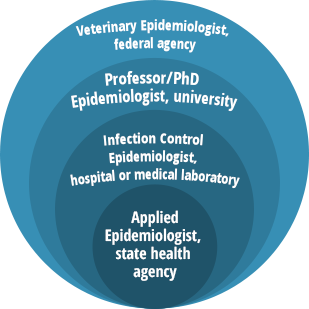
Epidemiology covers a wide range of settings and subject areas. The questions below can help you identify which specialty fits your interests and working style.
1Do you enjoy working closely with members of the community?
2Do you like teaching?
3Do you enjoy teaching in an academic setting?
4Do you enjoy being involved in medical research?
5Do you enjoy working with animals?
6Do you enjoy working in the field?
7Do you like to manage others?
8 Do you like medical research on pharmaceuticals?
9Do you enjoy molecular biology?
10Do you enjoy working with diseases and disease outbreaks?
11Do you like working to save lives in the event of a disaster?
12Do you like working to prevent diseases and applying research to everyday problems?
Use your answers to find your best career match below:
Questions
Career path
Q1 & Q2
Epidemiologist in a local healthcare facility
Q2 & Q3
Professor / PhD Epidemiologist
Q5 & Q6
Veterinary Epidemiologist
Q4 & Q8
Pharmaceutical Epidemiologist
Q4 & Q9
Molecular Epidemiologist
Q6 & Q11
Disaster Epidemiologist
Q7
Supervisory Epidemiologist
Q6 & Q10
Infection Control Epidemiologist
Q1 & Q12
Applied Epidemiologist
Related Careers in Epidemiology
Epidemiology is a much more varied field than the popular image of a government statistician analyzing spreadsheets. Although data analysis is central to the work, the actual settings and subjects range from animal disease surveillance to pharmaceutical trials to disaster response. The careers below have strong growth projections and share significant overlap with core epidemiology skills. They’re worth knowing whether you’re plotting an epidemiology career or evaluating adjacent options.
Statisticians collect, analyze, and present data to help organizations understand complex problems. In public health and medical research, statisticians work alongside epidemiologists to design studies, validate findings, and model health outcomes. A strong background in epidemiology translates directly into this role. Current growth projections for statisticians are available on the Bureau of Labor Statistics website.
Community health workers connect the public to health resources, implement wellness programs, and collect health-related data at the community level. The role overlaps with applied epidemiology and is growing fast as health systems invest more in preventive and community-based care.
Projected growth (2022–2032)
14%
Median salary
$48,200
Spotlight: Veterinary Epidemiologist
Veterinary epidemiologists study the cause and spread of diseases within animal populations. It’s a role that sits at a critically important intersection: zoonotic diseases (those that jump from animals to humans) include some of the most serious infectious threats on record, from bovine spongiform encephalopathy (BSE, or mad cow disease) to avian influenza to swine influenza. Livestock industries also rely on veterinary epidemiologists to monitor herd health and prevent disease from spreading through food production systems.
Day-to-day duties include studying how diseases are transmitted among animals and between animals and humans, evaluating the efficacy of veterinary vaccines and medications, and analyzing field data to determine the cause of a given illness. Because data collection is time-intensive and often requires direct animal contact, much of the information analyzed by veterinary epidemiologists comes from veterinarians and veterinary technicians rather than directly from fieldwork.
Most veterinary epidemiologists are also licensed veterinarians. The path typically starts with a Doctor of Veterinary Medicine (DVM) degree, followed by licensure to practice. From there, the individual pursues additional training in epidemiology through an MPH or a PhD in Epidemiology. Board certification through the American College of Veterinary Preventive Medicine is not mandatory, but it’s strongly recommended for professional advancement. Requirements include two years of field experience in epidemiology, peer-reviewed publications, three professional references, and a passing score on the board exam.
Skills Every Epidemiologist Needs
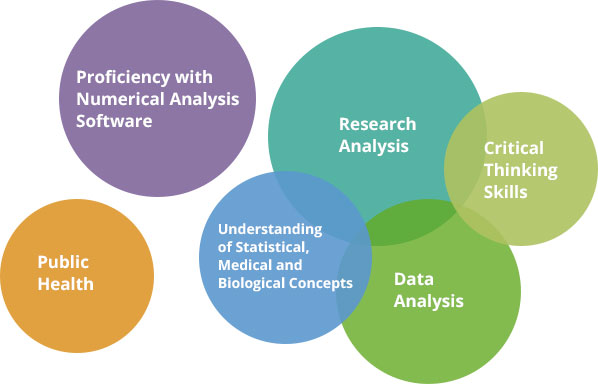
Technical knowledge alone doesn’t make an effective epidemiologist. The role also demands the ability to think critically with incomplete data, communicate findings clearly to non-technical audiences, and stay methodologically rigorous under pressure. These are the core competencies that matter most.
Statistical analysis
Perhaps the single most important technical skill an epidemiologist must have is the ability to use and interpret statistical tools. Gathering data is straightforward. Creating credible, actionable conclusions from that data is the actual work. Even epidemiologists not directly involved in data production must be able to critically evaluate study designs and test results for significance and accuracy.
Understanding of medical and biological processes
Statistical proficiency means nothing without a working knowledge of how diseases function in the human body. Understanding pathogen behavior, immune responses, and biological transmission mechanisms allows an epidemiologist to interpret the numbers and design interventions that work in practice.
Critical thinking
Data rarely speaks for itself. An epidemiologist needs to know which questions to ask, which analytical tools apply to a given problem, and where the gaps in available evidence are. The ability to reason carefully in the face of uncertainty is what separates strong epidemiological work from superficial pattern-matching.
Communication
Epidemiologists are paid to find patterns, draw conclusions, and develop recommendations. Those conclusions have to reach the people who can act on them, which means communicating clearly with government officials, hospital administrators, community members, and journalists. Finding a prevention method is only useful if you can get the right people to implement it.
Attention to detail
Epidemiologists must be precise in data collection and analysis, and they need to identify subtle patterns that may not be apparent to clinicians on the ground. Missed signals in surveillance data have historically allowed outbreaks to spread for weeks before detection. Accuracy and thoroughness aren’t optional.
Data and technology proficiency
Most data collection, storage, and analysis now run through software platforms and large databases. Epidemiologists need fluency with statistical software (SAS, R, Stata), electronic health record systems, and, increasingly, tools in geographic information systems (GIS) and data visualization. Familiarity with Big Data environments and predictive analytics is becoming a meaningful differentiator.
Popular Skills for Epidemiologists
Epidemiologist Salary
Epidemiologists earn well above the national median wage, reflecting the combination of advanced education, technical expertise, and public health responsibility the role requires. According to the Bureau of Labor Statistics, the median annual salary for epidemiologists in the United States in 2024 was $83,980. The top 10% of earners make more than $130,000 annually, while entry-level positions typically start around $57,000.
The industry you work in has the single biggest impact on where your salary falls within that range. State and local government positions make up the majority of epidemiologist jobs, but they also pay below the national median. Scientific research and development firms and private grantmaking organizations pay significantly more. The tables below summarize the differences by industry and by state, based on 2023 Bureau of Labor Statistics data. Note that state-level figures are derived from limited samples and may fluctuate year to year.
Industry
# Employed
Avg. Annual Salary
State Government
3,640
$79,030
Local Government
2,230
$78,240
General Medical and Surgical Hospitals
970
$104,690
Scientific Research and Development Services
720
$126,970
Colleges, Universities, and Professional Schools
720
$85,480
Grantmaking and Giving Services
370
$135,530
Specialty Hospitals
120
$116,820
State
Avg. Annual Income
Wisconsin
$121,150
Massachusetts
$114,300
Washington
$113,790
North Carolina
$110,410
New Jersey
$108,790
Kansas
$66,650
Mississippi
$64,830
West Virginia
$64,790
Louisiana
$62,240
Kentucky
$59,030
Building Your Epidemiology Career
New graduates enter a field that rewards proven work as much as credentials. A master’s degree gets you in the door. What happens next depends on the professional network you’ve built and the applied experience you bring to the table.
Your graduate program’s career services office is the first place to start. They maintain contacts at health departments, research institutions, and federal agencies, and they know which organizations are actively hiring. Beyond resume help, they can connect you with alums who are already in the field and willing to talk through how they got there.
Talking to classmates and professors pays off more than most new graduates expect. Classmates know who is hiring, which applications went somewhere, and which programs to approach. Professors with active research programs can serve as references, co-investigators, or informal introductions to colleagues at other institutions.
Joining professional organizations connects you to a community of people doing the same work. Organizations worth exploring include the Society of Healthcare Epidemiology of America (SHEA), the Council of State and Territorial Epidemiologists (CSTE), the American College of Epidemiology (ACE), the Association for Professionals in Infection Control and Epidemiology (APIC), and the American Epidemiological Society. Several offer job boards, mentorship programs, and volunteer opportunities that build experience alongside credentials.
The CDC runs several fellowship and training programs specifically for epidemiology students and early-career professionals:
The Epidemiology Elective Program
The CDC Experience Applied Epidemiology Fellowship
The Epidemic Intelligence Service
The CDC/CSTE Applied Epidemiology Fellowship Program
David H. Schwartz, PhD
Head of Scientific Support to Counsel, Innovative Science Solutions, LLC
“When you have finished your educational training and obtained your degree, try to gain some experience in government service. This could include a policy position or a position at a regulatory agency, even if it is for only a limited amount of time. Understanding this perspective will be invaluable to you no matter what you choose to pursue longer term.”
Epidemiologists investigate the patterns and causes of disease and injury in human populations. They collect and analyze data from field investigations, clinical studies, and surveillance systems, then use those findings to guide public health interventions, inform policy decisions, and improve disease prevention strategies. Some work on active outbreak responses. Others focus on long-term research into chronic disease or population health trends.
How long does it take to become an epidemiologist?
Most epidemiologists complete a four-year bachelor’s degree followed by a two-year master’s program, making the minimum timeline around six years of higher education. Many also spend one to two years gaining relevant work experience before entering a graduate program, which can extend the path to seven or eight years. Senior and research-focused positions often require a doctoral degree, adding 3 to 5 years beyond the master’s.
What degree do you need to become an epidemiologist?
A master’s degree is the standard entry-level requirement for most epidemiologist positions. The most common option is a Master of Public Health (MPH) with a concentration in epidemiology from a CEPH-accredited program. A Master of Science in Epidemiology is also widely accepted. Doctoral degrees are required for senior research roles, faculty positions, and positions directing major studies at federal agencies like the CDC or NIH.
What is the average epidemiologist’s salary?
According to the Bureau of Labor Statistics, the 2024 median annual salary for epidemiologists is $83,980. Salaries vary considerably by industry and location. Epidemiologists in scientific research and grantmaking organizations earn significantly more than the median, while those in state and local government positions typically earn somewhat less. Geographic location also plays a significant role, with states like Wisconsin, Massachusetts, and Washington reporting higher average wages.
Is epidemiology a good career?
For people drawn to data-driven problem solving and public health impact, epidemiology offers strong long-term prospects. The Bureau of Labor Statistics projects 16% job growth from 2024 to 2034, which is much faster than the national average. The work is technically demanding, requires sustained investment in education, and is often tied to government funding cycles. Still, it also offers a meaningful public health impact and above-average compensation for those who advance in the field.
Key Takeaways
Epidemiologists investigate the patterns, causes, and spread of disease in human populations, working in both active outbreak response and long-term research settings.
A master’s degree is the standard entry-level requirement. Most epidemiologists hold an MPH with an epidemiology concentration from a CEPH-accredited program.
The 2024 median annual salary is $83,980 according to the Bureau of Labor Statistics, with employment projected to grow 16% through 2034, much faster than the national average.
Most epidemiologist positions are in state and local government, but growing opportunities exist in hospitals, research institutions, pharmaceutical companies, and health technology firms.
Professional certifications like the CPH and CIC are optional but can strengthen your standing with employers, particularly in infection control and public health policy roles.
Ready to explore degree programs in epidemiology? Browse accredited MPH and epidemiology programs by state and find options that fit your goals.
Laura Bennett, MPH is a public health professional with over 12 years of experience in community health education and program coordination. She specializes in helping aspiring professionals explore flexible education pathways, including online and hybrid public health degree programs. Laura is passionate about making public health careers more accessible through practical, accredited training
2024 US Bureau of Labor Statistics salary and job market figures for Epidemiologists, Statisticians, and Community Health Workers represent state and national data, not school-specific information. Conditions in your area may vary. Data accessed May 2026.